TypeScript 7.0: Why a 10× Faster Compiler Changes the Developer Experience
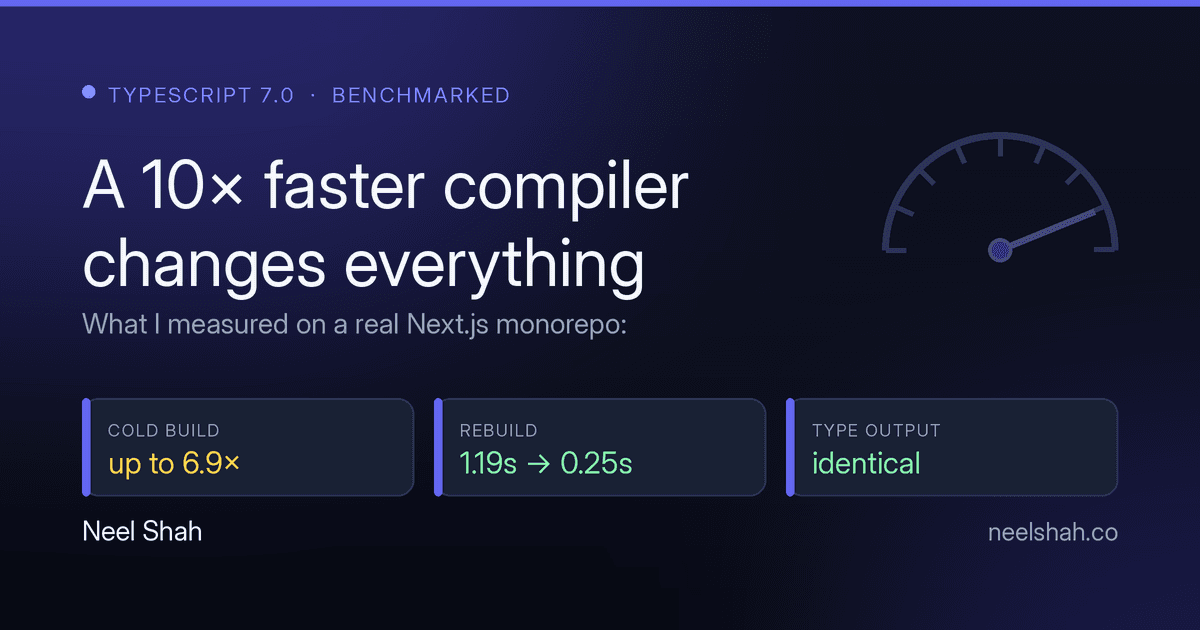
TypeScript 7.0: Why a 10× Faster Compiler Changes the Developer Experience
By Neel Shah · August 13, 2026
On July 8, 2026, Microsoft shipped TypeScript 7.0 — and it's not a normal release. The type system barely changed. What changed is the foundation underneath it: the entire compiler and tooling were ported from TypeScript to Go, producing native, multithreaded binaries. Microsoft reports typical full-build speedups of 8× to 12×, with editor and CI workflows seeing similar gains.
If you write React, Next.js, or Node.js, this is the most consequential tooling change in years — not because your code behaves differently, but because the feedback loop you live in all day just got roughly ten times tighter. Let's unpack what actually changed, what it does and doesn't speed up, and then I'll share the numbers I measured running it on my own 203k-line monorepo.
How the old compiler worked
Since day one, TypeScript's compiler was itself written in TypeScript. That's elegant — the language type-checks its own source code — and it served the project well for over a decade. But it came with a structural ceiling.
Because the compiler was TypeScript compiled to JavaScript, every type-check ran on a JavaScript engine. That means:
- Single-threaded execution. JavaScript has no shared-memory concurrency, so the compiler couldn't spread type-checking across CPU cores. On a 16-core machine,
tscused one. - JIT overhead. The JavaScript engine has to warm up and just-in-time compile the compiler itself before it does any useful work.
- Garbage-collection pressure. The type-checker allocates enormous graphs of objects, and the GC has to chase all of them.
- No inline struct allocation. JavaScript objects are heap-allocated and pointer-chased, which is death by a thousand cache misses at scale.
For small and mid-size projects this was fine. But as codebases grew into the millions of lines, teams started hitting the wall — slow editor startup, multi-minute CI type-checks, and even out-of-memory crashes. As Anders Hejlsberg, TypeScript's lead architect, put it, the team had reached the limit of what could be squeezed out of JavaScript.
Why go native — and why Go specifically
In March 2025 the team announced the fix (codename Corsa): a full port of the compiler to native code. The choice of language set off a genuinely educational internet argument, because they picked Go — not Rust, not C#.
The reasoning is worth understanding, because it explains why you can trust the result:
- It's a port, not a rewrite. The single most important decision. The Go code mirrors the structure and logic of the original TypeScript compiler line-for-line where possible. That's why it landed in about a year instead of never, and why it produces the same errors on the same code — just faster.
- Why not Rust? The compiler leans heavily on shared mutability and cyclic data structures (a type graph is full of cycles). Those clash head-on with Rust's ownership model and borrow checker. Porting to Rust would have meant a multi-year, from-scratch rewrite yielding an incompatible TypeScript nobody could adopt.
- Why not C#? Microsoft's own language is bytecode-first, its ahead-of-time compilation isn't uniform across every platform, and it's heavily object-oriented — whereas TypeScript's compiler is written in a functional, data-structure-heavy style that maps cleanly onto Go.
- Why Go, then? Hejlsberg framed it as "the lowest-level language we can get to and still have automatic garbage collection" — native code on every platform, tight control over data layout, comfort with cyclic structures, and cheap shared-memory concurrency via goroutines.
That last point is where most of the speed comes from.
Shared-memory parallelism
Running on real threads with shared memory, TypeScript 7 can do work concurrently that the JavaScript version simply couldn't. Parsing, type-checking, and emitting now run in parallel, and the team exposed knobs to tune it:
--checkerssets the number of parallel type-checking workers (default 4). Each worker gets its own consistent view of the program, and given the same inputs they always divide and check files identically — so results stay deterministic. More checkers can mean faster builds on many-core machines, at the cost of more memory.--builderscontrols how many project-reference builds run at once under--build. This is the one that matters for monorepos with lots of packages. It multiplies with--checkers, so--checkers 4 --builders 4can spin up 16 type-checkers — easy to overshoot.--singleThreadeddisables parallelism entirely. Useful for debugging, constrained environments like small CI runners, or apples-to-apples benchmarking against TypeScript 6.
Microsoft's numbers show the scaling. Their default---checkers 4 benchmark put the VS Code codebase at an 11.9× speedup; bumping to --checkers 8 on the same machine took it to 16.7×. The right setting depends on your cores, your memory, and your project — which is exactly why you should measure your own (I did; scroll down).
The distinction that matters: compiler speed ≠ runtime speed
This is the part that separates people who understand the release from people repeating the headline. TypeScript 7 does not make your application run faster.
TypeScript is a build-time and edit-time tool. It type-checks your code and emits JavaScript. The JavaScript it emits in version 7 is the same as what version 6 emitted — same output, same runtime behavior, same performance in the browser or in Node. What got 10× faster is the compiler and language tooling: the type-check, the build, the editor responses.
So the wins are all in developer experience and infrastructure, not in your shipped bundle:
- Your
tscand CI type-check finish faster. - Your editor responds faster.
- Your bundle size and app runtime are unchanged.
If someone tells you TypeScript 7 "makes your app 10× faster," they've misunderstood what a compiler does. Getting this right in your own writing is a quick credibility signal.
What actually gets faster (with Microsoft's numbers)
Here's what the TypeScript team published, benchmarking full builds of real open-source codebases (TypeScript 7 at its default --checkers 4):
| Codebase | TypeScript 6 | TypeScript 7 | Speedup |
|---|---|---|---|
| VS Code | 125.7s | 10.6s | 11.9× |
| Sentry | 139.8s | 15.7s | 8.9× |
| Bluesky | 24.3s | 2.8s | 8.7× |
| Playwright | 12.8s | 1.47s | 8.7× |
| tldraw | 11.2s | 1.46s | 7.7× |
Memory use dropped too — roughly 6% to 26% lower across those same projects, which matters most on memory-starved CI runners. (I saw the same pattern on my own repo — more on that below.)
Translated into the parts of your day:
- IDE responsiveness. On the VS Code codebase, opening a file with an error went from about 17.5 seconds to under 1.3 seconds — over 13× faster. Canva reported first-error time in their editor falling from about 58 seconds to roughly 4.8. Microsoft also measured the new language server producing about 80% fewer failed requests and 60% fewer crashes than the TypeScript 6 server.
- CI/CD. Slack reported cutting type-check time in CI from about 7.5 minutes to 1.25, and eliminating 40% of their merge-queue time. Microsoft's own News Services team estimated saving around 400 hours a month of CI waiting.
- Monorepos. Between
--buildersparallelism across packages and the raw per-project speedup, large multi-package repos — where type-checking was often the slowest step — benefit the most. - Large React/Next.js projects. Plain
.ts/.tsxReact and Next.js code is exactly the sweet spot: it type-checks throughtscand the native language server with no special toolchain, so you get the full speedup in both CI and editor.
TypeScript 6 → 7 migration considerations
Here's the mental model for the versioning: TypeScript 6 is the final JavaScript-based line, and it deliberately shipped a batch of new defaults and deprecations to smooth the path. TypeScript 7 is the native Go compiler; it adopts 6.0's defaults and turns 6.0's deprecations into hard errors. Practically, code that compiles cleanly on 6.0 (with stableTypeOrdering on and no ignoreDeprecations) should compile identically on 7.0.
So the smoothest route is: upgrade to 6.0 first, clear the warnings, then move to 7.0. Watch for these specifically:
- Changed defaults.
strictis nowtrue,moduledefaults toesnext,rootDirdefaults to./(projects whosetsconfig.jsonsits abovesrcwill need to set"rootDir": "./src"), andtypesnow defaults to[](you must list the@typespackages you actually rely on, e.g."types": ["node", "jest"]). Those last two are the most likely to surprise you. - Removed options, now hard errors.
target: es5,downlevelIteration,baseUrl,moduleResolution: classic/node/node10, andmodule: amd/umd/systemjs/noneare gone;esModuleInteropandalwaysStrictcan no longer be set tofalse. - Template literal types now preserve Unicode code points. Inferring from a template literal treats an emoji as one unit instead of splitting a surrogate pair — more intuitive, but a breaking change if you had type-level string utilities that modeled UTF-16 code units.
- Reworked JavaScript/JSDoc support. If you type-check
.jsfiles via JSDoc, several Closure-era patterns are no longer specially recognized and now align with how.tsfiles are analyzed. - No programmatic API in 7.0 (yet). This is the big one for tooling. 7.0 ships without an API; a new one is slated for 7.1. Until then, anything that imports from
typescriptprogrammatically —typescript-eslint, webpack loaders, and Volar-based language tooling — needs TypeScript 6. Microsoft ships a compatibility package (@typescript/typescript6, exposing atsc6binary) so you can run both side-by-side via npm aliases. - Embedded languages still need TS 6 for now. Because of the missing API, Vue, Svelte, Astro, MDX, and Angular template type-checking can't use the native language server yet. The practical workaround: use TypeScript 7's
tscfor fast project-wide CLI checks, and keep TypeScript 6 for the editor experience in those files until 7.1 lands.
Practical note for a typical Next.js + MDX stack: your
.ts/.tsxgets the full TS 7 treatment in both CI and editor, but MDX-embedded types fall back to the TS 6 language service until the ecosystem catches up. That's a per-file-type nuance, not a blocker.
Should you upgrade immediately?
It depends on what you lean on:
- Upgrade now if you mostly want faster CLI type-checking and CI, and your project is plain TypeScript / React / Next.js. You can adopt 7's
tscfor builds while keeping 6 for any editor plugins that still need it. - Wait a beat if you depend on the programmatic compiler API, custom transformer plugins, or embedded-language toolchains (Vue/Svelte/Astro/MDX/Angular) for your editor experience. Track the 7.1 API before switching those fully.
The low-risk play most teams are taking: adopt 7.0 for CI type-checking today (biggest, safest win), and phase in editor and tooling as the ecosystem lands on the new API.
I benchmarked it on my own monorepo
Headline numbers are someone else's codebase, so I ran the same comparison on mine: a 203k-line Next.js monorepo — 2,219 TypeScript files across three workspaces (a 65k-line frontend app, plus two shared UI-kit packages at 44k and 93k lines). TypeScript 6 vs 7, cold and incremental builds, three runs each, medians reported, tsc at its default --checkers 4, on [your CPU / core count]. I type-checked each workspace as its own project rather than the whole repo in a single pass.
How I tested
Install both compilers side-by-side via npm aliases, so tsc is v7 and tsc6 is v6:
{
  "devDependencies": {
    "@typescript/native": "npm:typescript@^7.0.2",
    "typescript": "npm:@typescript/typescript6@^6.0.2"
  }
}
Cold builds with hyperfine, clearing the incremental cache each run:
hyperfine --warmup 1 --prepare 'rm -f tsconfig.tsbuildinfo' \
  'npx tsc6 -p tsconfig.json --incremental false' \
  'npx tsc  -p tsconfig.json'
Incremental builds — warm the cache, touch one file, then time the rebuild:
npx tsc -p tsconfig.json --incremental   # warm
hyperfine 'npx tsc -p tsconfig.json --incremental'
Peak memory with GNU time (the Maximum resident set size line), and I logged the error count on every run so I could confirm the two versions produced identical output:
/usr/bin/time -v npx tsc  -p tsconfig.json 2>&1 | grep "Maximum resident"
/usr/bin/time -v npx tsc6 -p tsconfig.json 2>&1 | grep "Maximum resident"
The results
| Lines of code | Mode | TS 6 | TS 7 | Speedup | Peak memory |
|---|---|---|---|---|---|
| 44k (package) | Cold build | 2.91s | 0.54s | 5.4× | −17% |
| 44k (package) | Incremental | 0.76s | 0.12s | 6.3× | −49% |
| 65k (app) | Cold build | 4.81s | 1.07s | 4.5× | +3% |
| 65k (app) | Incremental | 1.19s | 0.25s | 4.8× | −36% |
| 93k (package) | Cold build | 4.71s | 0.68s | 6.9× | −19% |
| 93k (package) | Incremental | 1.00s | 0.16s | 6.2× | −49% |
What the results mean
I got 4.5–7×, not 10× — and the reason is instructive. I type-checked each workspace as its own project (44k–93k lines, 3–5 seconds each on TypeScript 6), not the full 203k-line repo in one shot. At that per-project size, a fixed slice of TypeScript 7's time is startup overhead — spinning up the process and workers — that doesn't shrink no matter how fast type-checking gets. On Microsoft's million-line benchmarks that overhead is a rounding error and parallelism dominates, so they see 8–12×. (A single tsc --build across all three workspaces with --builders might amortize that overhead better and land higher — a test for next time.)
And it's not a clean "bigger is faster" line. My largest workspace (93k lines) did post the top speedup at 6.9×, but the 65k-line app came in lowest at 4.5× — below the smaller 44k-line package at 5.4×. Raw line count isn't the whole story: the app is JSX-heavy, pulls in a more heterogeneous set of dependencies, and was the one workspace carrying type errors — all of which make its type-checking shape different from the uniform UI-kit packages. The takeaway: speedup rises with size at the top end, but code shape matters as much as LOC. For most real projects, expect a solid 4–7×.
The multiplier isn't the point — crossing "feels instant" is. Look at the incremental builds, the rebuild that runs while you edit. TypeScript 6 sat at 0.76–1.19s: long enough to notice, long enough to glance at another tab. TypeScript 7 came in at 0.12–0.25s — under the ~0.3-second threshold where a response stops feeling like waiting and starts feeling instant. That perceptual jump changes whether you stay in flow, and no ratio fully captures it.
It really is the same TypeScript. Because I logged error counts, I could verify the "faithful port" claim on my own code: my frontend workspace reported 6 type errors on both versions, and the two packages reported 0 on both. Same code, same errors — the port didn't change what type-checks. That's the reassurance that makes this a low-risk upgrade.
Two wins stacked: less work and more threads. On the 65k-line app's cold build, TypeScript 6 burned ~8.4s of user CPU; TypeScript 7 used ~4.8s — roughly half the total work, from native code beating JIT-compiled JavaScript. Wall-clock time then dropped further because that work spread across the parallel checkers (TS 7's user-CPU seconds exceed its real seconds, which only happens with multiple threads running). Native efficiency and parallelism compound.
Memory: a real win on the inner loop. Cold-build peak memory was flat-to-lower (the app's cold build was actually 3% higher — the only regression I saw), but incremental builds used 36–49% less memory. For watch mode and the editor language server, that's the number that counts.
If you run this on a codebase larger than mine, I'd genuinely like to see how close to 10× you land — send me your table.
Key takeaways
- TypeScript 7.0 is a faithful Go port of the compiler — same type-checking output, roughly 8–12× faster builds on large codebases.
- The speed comes from native code plus shared-memory parallelism (
--checkers,--builders), not from any type-system change. - It speeds up builds, CI, and your editor — it does not change your app's runtime or bundle.
- On my own 203k-line monorepo (2,219 files) I measured 4.5–7×, with the speedup rising on larger workspaces but shaped as much by code complexity as by line count — plus incrementals dropping into feels-instant territory, ~36–49% less memory on the inner loop, and identical error counts across versions confirming the output is unchanged.
- Migrate via 6.0 first; the sharp edges are the new
rootDir/typesdefaults, removed compiler options, and the missing programmatic API (coming in 7.1) that keepstypescript-eslintand Vue/Svelte/Astro/MDX/Angular tooling on 6.0 for now. - The safe first move is adopting 7.0 for CI type-checking while phasing in editor tooling — and benchmarking your own project rather than trusting the headline.
Sources & further reading
- Announcing TypeScript 7.0 — official announcement, Microsoft DevBlogs (devblogs.microsoft.com/typescript/announcing-typescript-7-0)
- "A 10x Faster TypeScript" / the native port announcement, Microsoft DevBlogs (March 2025)
- microsoft/typescript-go — the native port's source repository, including
CHANGES.md(TS 6 → 7 differences) - "Microsoft TypeScript Devs Explain Why They Chose Go Over Rust, C#," The New Stack — the clearest write-up of the Go-vs-Rust reasoning
Neel Shah
Contract full-stack developer building e-commerce and SaaS products with Next.js, Node.js and MongoDB from Ahmedabad, India.
Work with me →// contact
Working on something similar?
Happy to compare notes or help out — say hello.